
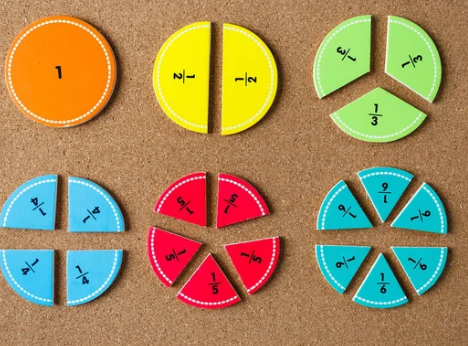
Fractions represent parts of a whole, and mastering them is essential for everyday tasks like cooking, budgeting, or measuring.
Adding Fractions
To add fractions, make sure the denominators (bottom numbers) match.
Example:
1/4 + 2/4 = 3/4
If denominators differ, find a common denominator.
Subtracting Fractions
Subtract just like adding—ensure denominators match.
Example:
5/6 – 1/6 = 4/6 (simplify to 2/3)
Multiplying Fractions
Multiply straight across—no need for common denominators.
Example:
2/3 × 4/5 = 8/15
Dividing Fractions
Flip the second fraction (take the reciprocal) and multiply.
Example:
3/4 ÷ 1/2 = 3/4 × 2/1 = 3/2
Why Fractions Matter
Fractions teach proportional thinking, support algebra skills, and help us solve real-world problems with precision.